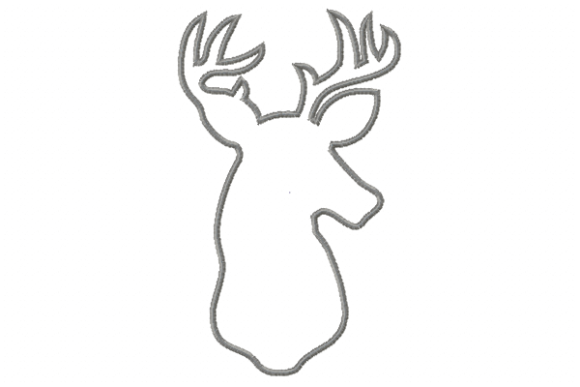
Reviewing the Reindeer Applique for Real Projects
As a designer who has spent countless hours hooped up at the machine, I have learned that not every machine embroidery design is created equal. Some look stunning on a screen but turn into a tangled mess of thread on fabric. Others are simple yet incredibly effective when applied to the right product. Recently, I downloaded the Reindeer Applique from a collection of Freebies to test its viability for my current client work. What follows is my honest assessment of how this design holds up in real-world Embroidery scenarios.
First Impressions and Visual Mood
The first thing that strikes you about the Reindeer Applique is its gentle, approachable aesthetic. It does not try to be overly complex or hyper-realistic. Instead, it leans into a charming, storybook quality that feels immediately nostalgic. For designers, this is a crucial distinction. A design that is too detailed can often get lost in the texture of certain fabrics, whereas a cleaner silhouette, like this one, tends to read well from a distance.
The layout suggests a classic applique structure, likely utilizing a combination of running stitch for placement lines, a satin or dense zigzag for the edge finish, and potentially some minimal fill stitch details for facial features or antlers. This simplicity is not a drawback; it is a strategic advantage. It means the design is versatile enough to sit comfortably on a variety of items without overwhelming the base material.
Real-World Application: The Holiday Tote Test
To truly evaluate a design, you must imagine it on a finished product. I envisioned this Reindeer Applique on a heavy canvas tote bag, intended as a reusable gift wrap alternative for the holiday season. This is a common request for Etsy sellers and craft business owners looking to expand their seasonal offerings.
In this scenario, the design performs exceptionally well. The bold shapes of the reindeer allow for high contrast against neutral canvas colors like oatmeal, kraft brown, or deep forest green. When stitched out, the applique technique reduces the overall stitch density compared to a fully filled design. This is critical for tote bags because it prevents the fabric from puckering or becoming stiff. A customer carrying groceries or books wants a bag that remains flexible, not a rigid board of thread.
Beyond totes, I see strong potential for this design in sweatshirt embroidery. Placed on the left chest of a heather grey crewneck, it acts as a subtle, festive accent. It avoids the "uniform" look of large back prints, offering a more boutique feel that appeals to buyers looking for custom apparel with a personal touch. For baby embroidery, such as on a onesie or burp cloth, the soft edges of an applique are safer and more comfortable against sensitive skin than dense satin stitches.
Navigating Fabric and Hoop Constraints
While the design is forgiving, it is not immune to the physics of embroidery. I would exercise caution when placing this on highly textured fabrics like thick wool coats or looped terry cloth. The precision of the applique edge might get lost in the pile of the fabric. In such cases, using a contrasting thread color for the tack-down stitch can help define the shape.
Another consideration is the hoop size. Since this is an applique, it likely requires a hoop large enough to accommodate the fabric piece being applied, not just the final design dimensions. If you are working with a small 4x4 inch hoop, ensure the design fits comfortably with room for stabilization. For curved surfaces like caps, the flat nature of applique works better than raised 3D foam, but you must still use a cap frame and appropriate stabilizer to prevent shifting during the high-speed stitching process.
Commercial Viability and Brand Consistency
For small shop product creators, consistency is key. The Reindeer Applique offers a cohesive look that can be easily integrated into a broader holiday collection. You could pair it with matching snowflake or tree designs to create a themed line of personalized gift items. This helps build brand recognition, as customers begin to associate your specific style of clean, charming appliques with your shop.
From a production standpoint, appliques are generally faster to stitch than full-fill designs. This efficiency translates to lower production costs and higher throughput during the busy holiday rush. However, they do require an extra step: cutting the fabric. For a digital embroidery file user, this means factoring in the time for manual trimming. If you are scaling up, consider whether your workflow can handle the additional labor of cutting multiple fabric pieces for each item.
Technical Notes for the Designer
Before committing to a full production run, always follow these practical steps:
- Test on scrap fabric: Never skip this step. Check how the thread colors interact with your chosen material. A dark thread on dark fabric may vanish, while a light thread on white fabric might look washed out.
- Check the license: Even though this was found among Freebies, verify the terms. Can you sell the finished product? Are there restrictions on digital resale? Always confirm licensing before listing items on Etsy or at craft fairs.
- Inspect stitch density: Look closely at the preview. If the satin stitch border is too wide, it may curl. If it is too narrow, it may not cover the raw edge of the applique fabric adequately.
- Use proper stabilizer: For stretchy fabrics like jersey knits used in t-shirts, a cut-away stabilizer is often necessary to maintain shape after washing. For woven fabrics like quilting cotton, a tear-away may suffice.
- Mockup in black and white: This helps you see the value and contrast of the design without the distraction of color. If the shape reads clearly in grayscale, it will likely work well in any color scheme.
Final Verdict
The Reindeer Applique is a solid addition to any designer’s library, particularly for those focusing on holiday-themed handmade product lines. It balances charm with practicality, offering a low-density option that respects the integrity of the fabric. While it requires the extra manual step of cutting fabric, the resulting professional look and comfort make it worth the effort. Whether you are creating a cozy pillow cover, a festive tea towel, or a custom embroidered patch, this design provides a reliable foundation for high-quality results. Just remember to test, stabilize, and verify your rights before you start stitching.